



Business VoIP Shopping Guide

Shopping for Business VoIP Telephone Systems
Top Ten Things to Know

VoIP (Voice over Internet Protocol) is quickly becoming the modern standard in business communications.  Unified communications are the wave of the future.  Here are the important things to know when shopping for a VoIP system.

1) VoIP Service Providers
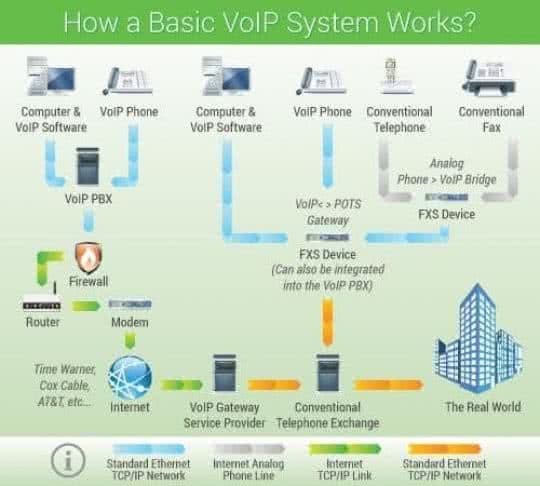
There are two main types of VoIP options to choose from, a hosted VoIP service or purchasing VoIP equipment.  Hosted VoIP service (also referred to as a virtual PBX) is the most common solution for small and medium businesses. With hosted service, the hosted service provider supplies the VoIP system managed and hosted externally to your company. The only equipment you will need to purchase will be the IP telephones and many times these can be leased as well.

Alternatively, you may opt to purchase your own VoIP phone system.  In this case, the business buys the phone system from a systems integrator, often the same provider that services or maintains your current LAN network, and the systems integrator installs the equipment on your premises. Your business or a contractor you hire is responsible for the maintenance and operation of the system, ie hardware, software, firmware etc.

If you purchase the system, keep in mind that there may be additional network equipment needed as well as dedicated servers and reliable battery backup systems. Network integrity testing should also be done before implementing a customer owned solution. 

2) Cost
There are cost savings to consider when implementing VoIP for your business.  A study done by Nemertes Research, called “Convergence: Reality at Last”, found that the typical implementation cost per CPE (customer premises equipment) VoIP user ranged from $525 for deployments of over 1,000 users to $763 for deployments of 100 or less.  As users increase, though, so do the savings per user.  Price ranges for hosted VoIP services average between $2,000 to $3700 per month based on 20 phones with a  T-1.  Hosted services require one-time set-up and activation fees that typically range between $500 and $1,000.  To compare and find recent prices click here on this link: Business VoIP Telephone System Prices. Hosted VoIP phone service affords the small business the ability to get high-end services at a fraction of the initial CPE outlay costs.

3) Reliability
VoIP, while once considered unstable, has now become a reliable communication solution. Distributing call processing functions across the network eliminates any single point of failure. Choppy calls, once the number one complaint among users, have now stabilized thanks to newer technology and better networks. Providers are moving towards a new standard for the VoIP network, H.323. Power backup systems are normally utilized to keep the network up in the case of a power outage.

4) Flexibility
Both hosted VoIP phone services, i.e. Hosted PBXs and customer owned VoIP systems (premise based IP PBXs) offer a great deal more adaptability than traditional PBX systems. Features can be added to telephone sets easily.  Changes can be made quickly. MAC (moves, adds and changes) activity is easily completed without the need for a technician to come to site, saving about $100 per visit. VoIP allows you to move your own telephone sets while keeping the telephone number and features intact. You simply unplug your phone and plug it into another jack location that is connected to the network.  As new features and applications are designed they can be added to your network.

5) Features
VoIP service & systems are feature rich. They provide all the traditional features you expect such as three-way calling, voicemail, speed dialing and caller ID. In addition, VoIP phone systems provide other more advanced features. These are just some of the many available features.

6) Maintenance
Hosted PBX VoIP providers offer time and cost savings by providing ongoing maintenance at their off-premise location. Customer owned VoIP solutions afford the ability to reduce administrative costs by incorporating all voice and data solutions into a single management interface.  This interface can often include gateways, controllers, telephones and applications.

7) Infrastructure
Traditional PBX telephone systems required at least one pair of wires to the desktop. With VoIP, only one cable (a data connection) is needed to the desktop, which will accommodate both voice and data.  The cost savings realized by running less cable in a new office scenario could average $70 to $100 per station.

8) Customer Service
An important consideration is the service level your provider offers. Hosted VoIP service providers typically offer an excellent range of options for service and maintenance. Look for service that includes 7 x 24 x 365 coverage. Many options also include a number of support hours that enable you to utilize provider network support.  MAC (moves, adds and changes) pricing is separate and providers usually offer a 24-hour turn-around time. Upgrades may be included in your package. The cost of your service plan will be based on the number of elements that are host controlled.  Ala Carte support items are also available.  Business VoIP providers offer competitive services that may be able to custom-tailor a plan for you, so ask your representative.

9) Productivity
Converged applications such as unified messaging enable users to spend less time working between different systems to retrieve messages.  With a VoIP phone service or system, your voice messages, e-mails and faxes can all be delivered to one desktop account.   Other capabilities such as click to call and Microsoft Outlook integration save time.  Efficiency also increases, as staff members are able to answer their calls no matter where they are with “find me – follow me” capabilities.  Phone tag is reduced.  A survey conducted by Sage Research showed an increase in productivity of up to 3 hours per week.

10) Cutting Edge
With its converged services and adaptability, VoIP phones are here to stay.  VoIP is easily updated to latest versions of software, giving you access to the newest technology available. This keeps you a step ahead of your competition, poised to allow even more enhancements.  The future offerings are limitless, with likely further integration to include CRM and other customized business process tools. 

To find out more about VoIP options, systems, and vendors, click here.

Back to Articles page.

Not a member yet? Sign up | Login