



The Small Medium Enterprise or Small Medium Business is viewed as the next exciting area of opportunity in the growth of Voice over Internet Protocol (VoIP) or IP Telephony (IPT). The scope of a system can range from a handful of telephones to dozens of voice and other terminals and from a single business location to multiple networked sites across the country. This article examines business VoIP in two parts: (1) telephone systems of today, and, going forward, (2) VoIP options.
Since as long as telephones have been around, businesses of all sizes-small, medium, and large-have used them. The pre-VoIP business of today can use a premises-based telephone system (such as a key system or PBX) for their business locations, or can use network-based (often called hosted) solution from a variety of service providers including telephone companies and other entities. The hosted offering could be as basic as a few "business telephone lines" from the provider, or it could be PBX-like capabilities delivered via the provider's equipment and network to the business. Let's look at these in a little more detail.
We've all seen key telephones although perhaps we didn't know the name at the time. The phones have multiple buttons (or "keys") with separate buttons that provide access to each "outside" (telephone company central office) line, intercom, and special features ("hold", et. al.).
The key telephone system (KTS) lets users:
(a) Access more than one central office line,
(b) Answer or access a central office line from more than one telephone, and,
(c) Place a line on hold in order to answer or initiate calls on other lines.
Usually the KTS includes an intercom capability that allows users on different telephones in the system to communicate with one another. By the way, the user gets dial tone from the central office when connected to an outside line for placing a call.
The components of a Key Telephone System are:
(1) Central controller or key service unit that provides the interface and switching between incoming central office lines and system telephones,
(2) Station cabling to connect each telephone to the key service unit,
(3) Multi-button telephone sets or key telephones,
(4) Power supply
System capacity depends on the key service unit. In a typical system, each incoming central office line appears on a separate button on every key telephone set that can make or receive calls on that line. Normally, a visual indicator, such as a small light, allows the user to tell if the line is in use. The same light flashes at a certain rate when an incoming call is ringing on the line, and flashes at a different rate when a call is on hold.
Recently, the feature set and add-on flexibility of a key system has grown to rival that of many small PBXs. Also, like its PBX brethren, key systems have utilized digital telephone technology for many years. Additionally, key telephone systems are now available that do not require a separate key system unit or central controller since the requisite intelligence and logic can now be built into each telephone.
Generally, if your company has more than 80-100 employees and/or you have specific advanced functionality demands, then you are likely to be using a PBX rather than a key system. The PBX was originally on the business site or premises-based, but in recent years more and more viable network-based or hosted alternatives have been developed as we will see in Part 2. The origins of the Private Branch Exchange (PBX) were in the early part of the 20th century when telephone switchboards first started to be automated. PBX technology has typically been a downsized version of telephone central office switches and associated equipment scaled for the enterprise or organization. The technology bases have gone from electromechanical to stored- program (i.e., computer) controlled, from analog to digital to ISDN to IP. The PBX, its peripherals, its phones were referred to (still are in some places) as Customer Premises Equipment or CPE.
The PBX connects office telephones in an enterprise or business with the public telephone network. It connects telephone company or other service provider lines (called "trunks") to the organization's users, and allows an organization to have fewer outside lines than extensions because statistically not all extensions will be in use at once. Without a PBX, an enterprise will need one line for every employee with a telephone, with a PBX system, the company only needs to have as many lines as the maximum number of employees that could be realistically making outside calls at one time. (This is could be as low as around 10% of the number of extensions, this statistical reduction is known as "concentration')
Every telephone is connected to the PBX. When an employee takes the receiver off hook and dials the code for external calls (usually "9"), the PBX connects the user to an outside line (again, referred to as a "trunk"). Additionally, the PBX performs other switching functions, connecting outside callers with inside extension lines and extensions with each other as needed.
The initial core functions of a PBX were to route and handle calls and to share common facilities such as central office trunks and access to specialized subsystems. Over time, many functions and features have been added. The list below is just a sampling of the magnitude of capabilities in and around today's PBX.
The care and feeding of a premises-based telephone system places demands on the business for attention, resources, and budget. Some are willing to give up ownership (and often, control) of their phone system, weigh budget and other operational tradeoffs, and evaluate the option of network-based or hosted alternatives. Some are unwilling to even consider any form of outsourcing. For all but the smallest of business sites capable of accommodation by multiple service provider lines, what this all reduces to is whether on not a hosted or "Centrex-like" approach makes sense for the business.
In terms of older definitions, Centrex (which originally meant "Central Exchange") is a PBX-like service offered by the telephone companies and other carriers in which the switching equipment is located at the service provider's site, not the customer premises. Basically, a "PBX" is offered to a customer that is crafted from the switching infrastructure and resources of the service provider. A key advantage of this is to get the PBX out of your building and locate it where the service provider is totally responsible for its operation, reliability, upgrades and performance, and where qualified service technicians and other support staff are available. The acquisition and maintenance costs of the PBX (capital expense) are traded off against the cost of leasing the Centrex service (operating expense).
Centrex-like and similar hosted variants such as the hosted PBX can often be the preferred solution for the small to medium-sized enterprise. This holds especially true for enterprises with multiple locations but it applies to others as well. Note that hosted solutions are no longer the exclusive domain of phone companies and carrier-centric providers; there are many new suppliers of hosted services including providers of hosted IP PBXs that we'll discuss in Part 2. Consider the model of the Internet and IP communications--it doesn't matter to the user (or client) where the server(s) are as long as the work gets done economically and efficiently. Hence why should it really matter that the PBX is on your physical site?
It is interesting to consider telephone systems currently in place. If you look at the numbers of existing telephone systems VoIP doesn’t have a strong showing, however as you will see in Part 2 VoIP telephone systems shipments have overtaken legacy TDM voice shipments as of 2005. An estimated break- out for traditional TDM voice solutions for low line size (<100) establishments is:
| Key Systems | 60% |
| PBX | 30% |
| Legacy Centrex | 10% |
For larger line sizes, PBXs start to dominate.
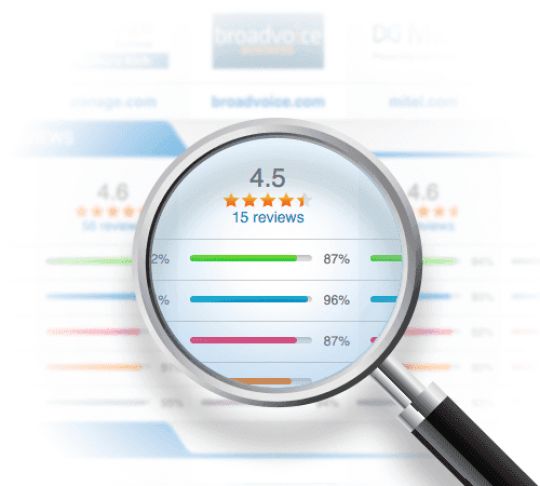
Traditional "Centrex" has declined over the years but has retained a niche in government and educational institutions. Centrex has a connotation to many as a mostly negative reminder of big telephone company dominance, high costs and inadequate features. Today's hosted PBX solutions, as we will discuss in Part 2, overcome these problems and are a very viable alternative. (To gain an understanding of the hosted IP PBX and other VoIP options available to you, use our business VoIP search tool at http://www.voipreview.org/Business_Telephone_Systems/.)
Note that all of the traditional voice solutions that we've looked at are independent of the customer's data communications and data networks. Voice and its systems and networks came first and "data" was carried by and handled by what was once a voice-only circuit-switched infrastructure. With the movement to VoIP and voice/data convergence, not to mention the expanded role of IT in a business of any size, that has changed. Let's turn now to Part 2 and options in the era of convergence.
There is no doubt that VoIP is the mainstream direction for voice. In early 2005, VoIP shipments overtook that of legacy TDM voice, and a significant portion of business telephony has already migrated to VoIP. Basically, the question of "Why VoIP?" has been replaced with "When VoIP?" For the small or medium-sized enterprise there are a number of scenarios.
"If it ain't broke, don't fix it" is a guideline for some people. There are many who are perfectly happy with PCs running Windows 98 and there really are folks without cell phones. There are businesses that can continue with their legacy voice systems, but sooner or later events, triggers, or self-assessments will happen that will cause those enterprises to re-examine telephony. When that occurs in today's (and tomorrow's) climate, business VoIP will be explored and likely be chosen as the next approach for the business. By and large, these factors are independent of any technological advantage that VoIP telephone systems may have over traditional systems such as enabling more employee mobility and work site geographic freedom.
The kinds of events, triggers, and realizations leading to new looks at the enterprise telephone system include:
Migration to VoIP can be done in numerous ways and it is dependent on the current technologies and number of sites of the business. (Moreover, since we are looking at business VoIP, the relation between voice and data at each business site and across the networks used by the business needs to be understood at some point, this will be examined in more detail in a future article on VoIP telephone systems.)
For the moment, let’s consider the business as being served by legacy premises-based telephone systems (key system or PBX) since that is the majority of current deployments. The options for transitioning to business VoIP then are:
A premises-based VoIP system can be an IP PBX or an IP- capable key system. Depending on what was at the business site previously, transitioning to a premises-based VoIP solution can result in replacing the incumbent telephone capability or upgrading it to add IP telephony. There are a variety of PBXs and key telephone systems from numerous vendors that can be upgraded by adding appropriate circuit cards, software, and other elements to provide VoIP at the business location without the need for "rip and replace". Typically, these systems permit "hybrid" operation of both circuit-switched telephony, and VoIP, and allow for a mix of IP and legacy telephones. However, depending on circumstances and the economics of the situation, replacement of the old system with a new IP PBX may be the appropriate choice for a premises-based scenario. Multiple site businesses are challenging for premises-based solutions especially when there are multiple PBX technologies that need to be networked for the business. More on that subject when we examine the tradeoffs between premises-based and hosted VoIP systems.
The network-based or hosted VoIP solution, often called the hosted PBX or hosted IP PBX represents a new breed of telephony. It provides network-centric IP applications (in this case voice and related capabilities) via an Internet-like model of servers (which can be resilient and secure) and geographically dispersed clients/users. The hosted approach shares some notions of service provider ownership/management and centralization with "Centrex", but as noted some years ago, "It's Not Your Father's Centrex".
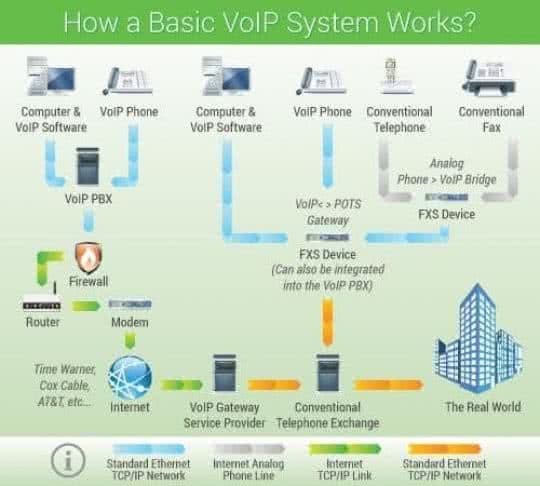
A hosted IP PBX system delivers IP PBX functionality as a service, available over a public or private network such as the Internet, a service provider's private network or a corporate Intranet. Rather than acquiring IP PBX equipment, users contract for services from a hosted service provider. The functions provided by a hosted IP PBX service are comparable to those of an IP PBX system installed at the user's premises. Hosted IP PBX customers don't buy, install, maintain or upgrade any IP PBX hardware or software; the IP PBX equipment is managed and operated by the service provider, who then shares access to the system among many users /customers. Customer site equipment to interface with the service typically consists of telephones (IP or legacy TDM with appropriate adapters), gateways, and a router for connecting to the site's LAN. Also, customers will often have system management and administrative access tools from the hosted service provider for making changes, adding/modifying individual user attributes, monitoring performance and the like.
The idea of using the public Internet for business VoIP communications may be problematic to some. However, experience with consumer residential services has shown that handling VoIP over the Internet works well, works reliably and it is generally acceptable to sender and receiver. Voice via the Internet was considered OK for the PC hobbyist a few years ago but was not looked at as "business grade". However, there has been much technological improvement from the days of "send and pray" to today. It is an option you may want to consider with regard to cost and voice quality tradeoffs in examining hosted VoIP services for a small or medium sized enterprise.
Let's go back now to our earlier introduction to transitioning to VoIP and consider some of the tradeoffs. In particular, the pros and cons of network-based or hosted VoIP vs. premises-based VoIP solutions
The hosted PBX approach has numerous advantages over the premised-based PBX solution for single or multi-site businesses
The hosted solution has additional benefits for multi-site deployments
There are a few disadvantages of the hosted approach such as the need to have a separate connection to the host for each user at a site, and the related notion that all calls (including the local ones across the office) must be "back-hauled" and handled by that host. Additionally, some functions are a little more complex when handled by a hosted PBX provider then they are when handled by a premises IP PBX. But, on balance, there are no feature disadvantages of network-based hosted IP PBX vs. premises-based IP PBX. Note further, that with Web-based system and user management tools, the hosted services customer has the same, if not better, control of moves, adds, changes, and other similar processes as the premises IP PBX customer.
With regard to cost, acquiring and operating a premise IP PBX can cost the enterprise customer more, perhaps many times more, than that of using the hosted IP PBX option. As always, your mileage will vary, every customer situation is different. (Once again go to http://VoipReview.org/Business_Telephone_Systems/ for insight into options and alternatives that you can consider when choosing business telephone systems based on VoIP).
The road to VoIP is interesting and challenging. Do your homework and enjoy the ride.